Articles del vol. 11: "Utopies i distopies: com serà el futur?"
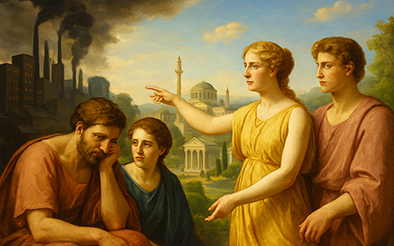
For some time now, films and television series have permeated the collective imagination with dystopian scenarios. From classic literary works such as 1984, Fahrenheit 451 and Brave New World, we find representations and distortions of social reality that are undesirable, either because they are authoritarian or because they suppress part or all of the defining features of the human condition.
In recent decades, other, more contemporary audiovisual productions have been added to dystopian discourse, such as V for Vendetta, Black Mirror or The Handmaid’s Tale, to name just a few, which likewise present dangerous scenarios, involving either the loss of freedom or the loss of humanity.
Cultural critic Mark Fisher observed that “it is easier to imagine the end of the world than the end of capitalism.” On this occasion, we wish to reflect on the possibility of a better future.
This was an idea shared by the often-overlooked Renaissance utopias, from Thomas More’s Utopia to Tommaso Campanella’s The City of the Sun and Francis Bacon’s New Atlantis. More’s work—the first to properly bear the name “utopia” (though not, in fact, the first of its kind)—was written in 1516 and centres on the fictional account of the Portuguese explorer Raphael Hythloday.
“Meanwhile, although I cannot agree with everything that man had explained—who, in other respects and beyond dispute, was a great scholar and an excellent connoisseur of human nature—I openly declare that in the republic of the Utopians there are many things that I truly wish, rather than hope, might be applied in our own cities.”
This testimony reveals the author’s scepticism regarding the feasibility of utopian proposals, yet it also amounts to a confession of a profound desire for the improvement of society. Perhaps today we need not be naively optimistic; it may suffice to explore the lights and shadows of utopia without abandoning the desire for a better world, even if, as More bluntly suggests, it seems impossible to realise.
Articles may also be submitted for other sections of the journal at any time.